MoreExam
1. Question Content...
EXPLANATION
Answer: X - EXPLANATION Content.
Question1: A customer is looking to implement a VMware solution with these requirements:Support for 200 call center employees on a single 8-hour shiftApplication access through physical Windows 7 desktopsRestrict access to only these applications: Google Chrome, FileZilla (an open source FTP application),and a custom in-house client-server call center applicationAn architect is tasked with determining the lowest cost license solution that will meet the customer’s requirements.Which solution should the architect choose?
Question2: An architect is designing Active Directory (AD) permissions for a Horizon environment that will use pre- existing computer accounts. The AD Security Team has restrictions about the use of service accounts.What two sets of minimum permission are needed to delegate to an AD service account? (Choose two.)
Question3: The CIO of a company has asked that a review of all user’s applications be undertaken to improve storage usage. After the review, it was found that a number of applications are used by several different organizations within the company. These applications are currently all installed in all of the different master images, making each of the master images very large.What VMware technology would improve storage usage?
Question4: An architect put these statements into a design:Horizon to integrate with current authentication solutions (directory services and two-factorauthentication mechanisms) for internal and external access.Desktop and application access and provisioning should be managed through current authenticationmechanisms.In which design category does the scenario fit?
Question5: A customer is struggling with how to support application delivery to its highly mobile sales force. There are two Windows applications that need to be delivered, which could present a challenge. Both applications use a local copy of the central database and the applications are frequently being updated.During assessments and user interviews, the sales personnel indicated that they frequently use these two applications while traveling in areas with poor connectivity. The sales people rarely connect to the company network. Pushing out updates using a traditional deployment system is therefore difficult.Which solution from VMware would solve the customer’s situation?
Question6: The IT team for a company wants to deploy VMware Horizon and allow end users to access their Horizon Windows desktops using Windows laptops, Android and iOS mobile phones, and Android and iOS tablets with the following requirements:High data securityLow client bandwidthLow client processor overheadLow storage spaceHigh image qualityWhich Horizon desktop pool meets these requirements?
Question7: A company wants to deploy Windows 8 Horizon desktops for end users with the following goals:Fast provisioningFast guest customizationMinimum storage spaceNo user profiles on the C: driveWhat must be implemented to meet these requirements?
Question8: The IT team for a small government organization wants to deploy Horizon Apps.It needs to provide Windows desktops to two groups of users.Most users only need a few Windows applications.It wants to minimize storage space required.It determined that they need 4 RDS Hosts, but more will be needed in the next 6 to 8 weeks.It installed and configured RDS on a Windows server VM, installed the Horizon Agent, and then theWindows applications.What steps must the organization perform next to create a scalable and flexible Horizon Apps deployment?
Question9: Which is a design decision when architecting a Workspace One on-premise implementation supporting Mobile Single-Sign On for iOS devices?
Question10: A company is deploying VDI and needs to meet these requirements:Support a bring-your-own-device (BYOD) strategySupport external contractorsSupport access from anywhereReduce or eliminate costly desktop and laptop replacementWhich two solutions should an architect recommend? (Choose two.)
Question11: An architect is asked to review a company’s plans to implement ThinApp packaged applications to its non- persistent Virtual Desktop Infrastructure (VDI). The applications must be assigned to users and not individual VDI desktops. All ThinApp packages are already available on a network share.Which two options can the architect recommend to meet requirements? (Choose two.)
Question12: A company wants to reduce updating and provisioning time for problematic legacy applications on virtual desktops.Which two Horizon technologies can meet the requirement? (Choose two.)
Question13: A company had a security breach which resulted in stolen data. The CIO has mandated that the security team implement a data leak prevention mechanism and better control over how data is accessed and distributed.Which technology will prevent users from copying data from their Horizon View virtual desktop to their local endpoint when they are connected outside the corporate LAN?
Question14: The IT team at a small government organization wants to deploy Windows RDS desktops to their end users. They want the end users’ profile and application customization setting preserved. They also want to deploy applications using VMware App Volumes.What should be implemented to meet requirements?
Question15: A company asked an architect to design a VMware Horizon View 7.1 solution utilizing security servers to support 7500 local network users and 3500 remote sales personnel.These requirements were requested:Design must provide high availabilityDesign must use VMware’s supported minimum number of connection serversAll users will connect with BLAST or PCoIPWhich two minimums can the architect recommend to meet requirements? (Choose two.)
Question16: In a local design, a company selected one database instance to be shared by Horizon View Composer database, vCenter external database, and Horizon AppVolumes database. The design must provide High Availability for all databases.Which two database server options should be selected during physical design creation? (Choose two.)
Question17: A VDI Architect wants to optimize Blast Extreme protocol between 400 Horizon Windows clients and agents on an organization’s LAN. No GPO currently makes Horizon settings to these clients or agents.What GPO setting will improve performance of these systems?
Question18: A hospital is looking to introduce a new work model. Their goal is to allow doctors and nurses to access care applications more flexibly. An important task is that Android and iOS tablets be allowed for hospital staff. The IT department is faced with the task of executing on the requirements.The current client environment is:Physical Windows 7 desktops and laptops2500 Windows based applications300 Web based applications, where 200 requires Internet ExplorerWindows applications are managed using Microsoft SCCMAny solution must be in production within 6 months. IT was approved to start building a non-optimized solution to get things started. At a later date, investments will be spent on optimizing the solution. There is no time for a proper application assessment and user segmentation, so the solution must support as broad a user base as possible.The main priorities for the design are:Time to marketChange as little as possible of existing management processesWhat solution would support the main priorities?
Question19: A company is implementing VMware Horizon View 7 solution. It has created four 500 linked-clone desktop pools to be used by different departments and workers. The company’s VDI administrator noticed that Horizon View Composer is showing in error state on the View Admin Web Console. During restart of the Composer service, the service failed to start up again. A decision was made to migrate View Composer to a new server and preserve the linked-clone information.What three steps are requires for the migration? (Choose three.)
Question20: A university struggles with Windows application delivery for its students. Students only need a few applications, but since IT is not in control of the Windows versions on the endpoints, it has been a challenge. IT wants to allow for self-service to minimize administration. Despite self-service, IT must be able to revoke access to applications within 30 days from students leaving the University.Which two solutions support the university’s requirements? (Choose two.)
Question21: A company has decided to virtualize all of its helpdesk employee’s workstations.These requirements must be met:All applications used by the employees will be published through RDS hosted application.Users will NOT be allowed to store any personal data on their Horizon desktops.The Horizon desktop design should meet maximum storage space efficiency.The Horizon desktop design should meet maximum performance.The Horizon desktop design should meet maximum power savings.Which three features can be enabled to meet the company’s requirements? (Choose three.)
Question22: A customer is deploying Horizon View 7.1 utilizing a Cloud Prod Architecture. The customer wants to utilize32-node clusters, and a single vCenter at each site to support 9,500 desktops per site.Which two statements about this configuration are true? (Choose two.)
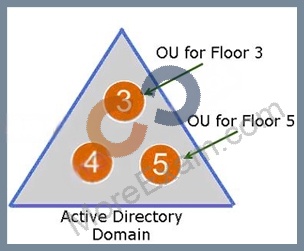
Question23: Company M recently acquired Company T. All Company M employees work in the same office building.Company T has multiple buildings. Company T uses a single domain Active Directory (AD) structure as shown in the exhibit. They place end users in one of several AD groups in an OU based on the floor of the building where that user’s office is located. Over the next six months, the IT team will be adding AD groups and user accounts for Company T employees.The IT team decided to implement VMware Horizon and deploy all end user applications using Horizon RDS application pools. All users need access to all Horizon RDS applications.After creating the Horizon RDS application pools, what task should the IT team perform to enable users access the applications with the least administrative effort?